
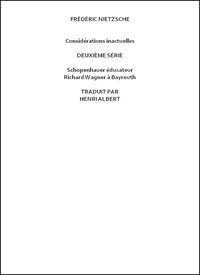
Considérations inactuelles, deuxième série by Friedrich Wilhelm Nietzsche
So, what's this book actually about? Don't let the fancy French title fool you. 'Untimely Meditations' is Nietzsche taking a sledgehammer to the popular ideas of his time. In this second part, he zeroes in on our relationship with history. It's 1874, Germany has just unified after winning the Franco-Prussian War, and everyone is patting themselves on the back, celebrating their 'great' history.
The Story
There's no traditional plot with characters. The 'story' is the argument. Nietzsche acts like a doctor diagnosing a cultural sickness. He says his society is suffering from a dangerous overdose of history. People are so busy studying the past, preserving every detail, and feeling proud of old victories that they've become passive. They're spectators of life, not participants. He argues this historical overload paralyzes action, kills genuine creativity, and makes people weak. They use the past as an excuse not to face the present or imagine a different future. The book is his attempt to shake them awake and ask: Is this knowledge serving life, or is it just a weight holding us down?
Why You Should Read It
This book hit me at the right time. In our age of endless documentaries, listicles about '10 Historical Facts You Didn't Know,' and nostalgia for every past decade, Nietzsche's warning feels eerily relevant. It made me pause my next Wikipedia deep-dive and ask: Am I collecting information, or am I building a life? His passion is contagious. You can feel his frustration and his genuine fear for the human spirit. This isn't a calm, balanced analysis. It's a thinker screaming from the page that there's more to being alive than curating the past. Reading it is like a mental cold shower—uncomfortable but incredibly clarifying.
Final Verdict
This is not an easy beach read, but it's surprisingly accessible for 19th-century philosophy. It's perfect for anyone feeling overwhelmed by the noise of the modern world, for the chronic over-thinker, or for the person who suspects that always looking backward might be a way of avoiding today. If you've ever scrolled through social media and wondered why everything feels like a rerun, Nietzsche offers a 150-year-old explanation that still cracks the code. Give it a try if you're ready for a challenging, provocative conversation with one of history's most restless minds.
This is a copyright-free edition. Preserving history for future generations.
Matthew Anderson
2 years agoThe clarity of the introduction set high expectations, and the objective evaluation of the pros and cons is very refreshing. I’ll definitely be revisiting some of these chapters again soon.
Patricia White
3 months agoThis was exactly the kind of deep dive I was searching for, the cross-referencing of different chapters makes it a great study tool. It’s a comprehensive resource that doesn't feel bloated.
Matthew Hernandez
1 month agoThe analytical framework presented is both innovative and robust.
James Smith
9 months agoFrom a researcher's perspective, the cross-referencing of different chapters makes it a great study tool. This should be on the reading list of every serious professional.



Patricia Martin
2 months agoThe clarity of the introduction set high expectations, and the formatting on mobile devices is surprisingly crisp and clear. Thanks for making such a high-quality version available.