
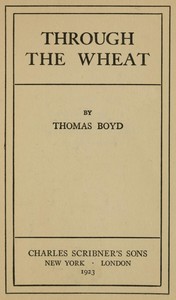
Through the Wheat by Thomas Boyd
Let's talk about a book that feels less like a novel and more like a direct line to the past. Thomas Boyd wrote 'Through the Wheat' because he lived it. He was a Marine in the Great War, and he poured every exhausting, terrifying, and disillusioning moment into this story.
The Story
We follow William Hicks, a young American who joins the Marines and ships off to France in 1918. Forget sweeping battle plans and clear objectives. Hicks's war is a blur of marching to the front, crouching in filthy trenches under shellfire, and launching into chaotic attacks across no-man's-land. The enemy isn't a faceless villain; it's the mud that sucks your boots off, the hunger, the deafening artillery, and the constant, gnawing fear. The plot isn't a series of epic victories. It's a slow, relentless wearing down of a man, showing how the daily reality of combat chips away at everything he thought he knew about himself and the world.
Why You Should Read It
This book's power is in its honesty. Boyd doesn't sugarcoat anything. There's no patriotic music swelling in the background. The dialogue is clipped and real, the descriptions are stark, and the emotional landscape is one of numbness and survival. You feel the weight of the pack, the jolt of the rifle, and the hollow feeling after the adrenaline fades. Reading it, you understand why this novel, published in 1923, felt so revolutionary. It came out years before 'All Quiet on the Western Front' and showed American readers the brutal, inglorious side of their own 'doughboys' experience.
Final Verdict
This is a must-read for anyone interested in authentic war literature or early 20th-century American realism. It's perfect for history buffs who want to move beyond the dates and generals to feel what the war was like for the guy in the trench. It's also for readers who appreciate character-driven stories about psychological survival. Be warned: it's not a cheerful read. But it's a short, powerful, and incredibly important one that reminds us of the true cost of war, told by someone who paid it.
You are viewing a work that belongs to the global public domain. You are welcome to share this with anyone.
Barbara Moore
1 year agoVery interesting perspective.
Carol Young
8 months agoWow.
Dorothy Martin
1 year agoWithout a doubt, it manages to explain difficult concepts in plain English. Worth every second.
Mason Anderson
1 year agoRead this on my tablet, looks great.