
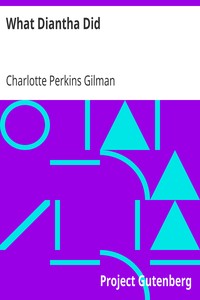
What Diantha Did by Charlotte Perkins Gilman
Charlotte Perkins Gilman is famous for the chilling short story "The Yellow Wallpaper," but What Diantha Did is her sunny, practical cousin. Published in 1910, it’s a novel with a mission, but one wrapped in a genuinely engaging story.
The Story
Diantha Bell is smart, capable, and engaged to the well-meaning but conventional Ross. When he pictures their future, he sees her as the angel of his home, managing the household for free. Diantha has a different vision. She proposes a trial: instead of marrying immediately, she will take six months to launch a business professionalizing domestic work. She starts small, taking on cooking and cleaning for a few families, but her ambition is huge. She creates a cooperative housekeeping service, a cooked food delivery system, and even a girls' training school—all designed to turn the chaos of home management into an efficient, paid profession. The plot follows her uphill battle against skeptical clients, a scandalized town, and her own fiancé’s doubts, as she proves her theories one satisfied customer at a time.
Why You Should Read It
What’s amazing is how modern Diantha’s ideas feel. Gilman isn’t just arguing for women’s rights in the abstract; she’s solving the real, daily problem of "who does the dishes?" with business plans and time-management charts. Reading it, you realize how much of our current conversation about unpaid labor, the service economy, and work-life balance was prefigured here. Diantha isn’t a suffering heroine; she’s a cheerful CEO-in-the-making. Her triumph isn’t about rejecting domesticity, but about valuing it enough to pay for it. The book’s optimism is infectious, even when it gets a bit didactic.
Final Verdict
This book is perfect for anyone interested in the roots of feminism, fans of historical fiction that’s light on romance and heavy on ideas, or readers who love stories about underdog entrepreneurs. If you enjoy seeing a clever protagonist systematically dismantle an outdated system with sheer competence, you’ll adore Diantha. It’s a fascinating, hopeful, and sometimes funny look at a past vision of a better future—one we’re still working toward.
This digital edition is based on a public domain text. It serves as a testament to our shared literary heritage.
Barbara Lopez
5 months agoIt’s rare to find such a well-structured narrative nowadays, the data points used to support the main thesis are quite robust. A mandatory read for anyone in this industry.
Jennifer Wilson
4 months agoBeautifully written.
Richard Nguyen
1 year agoI had low expectations initially, however the plot twists are genuinely surprising. I learned so much from this.
Steven Ramirez
1 year agoI didn't expect much, but the author's voice is distinct and makes complex topics easy to digest. Highly recommended.

Richard Jackson
9 months agoThe citations provided are a goldmine for further academic study.