
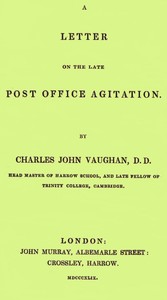
A Letter on the Late Post Office Agitation by C. J. Vaughan
Let's set the scene: London, 1891. The General Post Office, in an effort to give its overworked staff a break, announces it will end Sunday collections and deliveries. What followed wasn't just a quiet policy shift—it was a firestorm. C.J. Vaughan's A Letter on the Late Post Office Agitation is his direct entry into that public debate. Written as an open letter, it's his attempt to reason through the chaos and persuade his readers.
The Story
There isn't a traditional plot with characters. Instead, the 'story' is the argument itself. Vaughan lays out the case for the Post Office's decision. He acknowledges the immediate outrage from the public, who saw Sunday mail as a essential service, and from devout groups who worried about the secularization of the Sabbath if postal work stopped. His letter walks a tightrope. He defends the rights of postal workers to a day of rest, framing it as a moral and Christian duty of employers. At the same time, he tries to calm fears that this is a step toward a godless society. The drama comes from watching a thoughtful man navigate a public relations disaster, using logic, scripture, and appeals to public decency to make his case.
Why You Should Read It
This book is a crystal-clear window into the Victorian mind. What's amazing is how familiar the arguments feel. People were worried about work-life balance, about the pace of modern life, and about whether technology (in this case, efficient mail) was eroding community values. Vaughan's voice is calm and measured, which makes him a great guide through the hysteria. You see him genuinely trying to find a fair solution—one that treats workers humanely without completely upending public convenience. It's a masterclass in persuasive writing from a different time, and it makes you wonder what our own modern 'agitations' will look like to readers in 130 years.
Final Verdict
This isn't a book for someone looking for a thrilling novel. It's a niche, but brilliant, pick for anyone curious about social history, the art of argument, or the quiet moments when daily life and big ideas crash into each other. Perfect for history buffs who enjoy primary sources, for writers interested in rhetoric, or for anyone who's ever thought, 'Why is everyone so mad about this?' about a current news story. It's a short, smart reminder that public debates about progress and principle are never really new.
This content is free to share and distribute. Use this text in your own projects freely.
Robert Brown
3 months agoNot bad at all.
David Taylor
1 year agoThanks for the recommendation.
Liam Gonzalez
9 months agoA must-have for anyone studying this subject.






Oliver Hill
7 months agoGreat read!