1

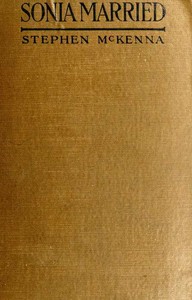
Sonia Married — Context and Discussion
918
6
Project Gutenberg
2014
Married people -- Fiction; Man-woman relationships -- Fiction; World War, 1914-1918 -- England -- Fiction; England -- Social life and customs -- 20th century -- Fiction
Readers of public-domain and historical texts
Project Gutenberg digital edition
en
Edition facts
Words: 129,349
Reading time: 563 min
Text sections: 12
Source:
Project Gutenberg record #46096
Stephen McKenna's sequel to 'Sonia' follows the married life of Sonia amid World War I, exploring tensions between personal desire and social duty through sharp dialogue and a cynical narrative voice.
Editorial Edition Score
4.8/5
★★★★★
★★★★★
Calculated from edition completeness, EPUB availability, text structure and catalogue metadata. Not a user rating.
Edition quality
Stephen McKenna's Sonia Married opens with an epigraph from Aesop's fable of Hercules and the Carter, a pointed warning against idle prayer without action. The novel, a sequel to Sonia, is framed as an epilogue or footnote by the author, who admits in the dedicatory letter that the marriage of Sonia and O'Rane was born of 'hysterical impulse' and 'contained the seeds of instant disaster.' The excerpts reveal a story told largely through conversation, with characters like Bertrand offering cynical, analytical commentary on the tangled relationships of Sonia, David, and Grayle. The war serves as a backdrop, testing the endurance of those who survive its repeated blows.
The Cynical Chorus
The narrative voice in Sonia Married is heavily mediated through dialogue, with Bertrand emerging as a detached, sardonic observer. In one exchange, he dissects Grayle's character with surgical precision: 'Grayle is becoming the calculating animal, Grayle for the first time in his life feels that he has a reputation to lose.' Bertrand's speech is laced with aphorisms and a weary knowingness, as when he declares, 'I don't much mind your healthy incontinent animal, but I hate your continent calculating man.' This voice provides a running commentary on the characters' self-deceptions, particularly Grayle's attempt to reconcile 'disreputable tastes with a decorous exterior.' The reader is positioned as a confidant, privy to the unvarnished assessments that the characters themselves avoid.
War's Lingering Shadow
The war is not a distant event but a persistent, corrosive presence. O'Rane's private meditation—'the courage, the cold, heart-breaking courage ... and the smile on a dying man's face'—reveals a crusading spirit that, by the novel's present, has faded. The dedicatory letter contrasts the early war's 'heady self-indulgence' of sacrifice with the later 'sickening repetition of one well-placed blow after another on the same bruised flesh.' This shift from initial fervor to exhausted endurance underpins the characters' moral struggles. The war tests not only their bravery but their capacity for memory and justice, as O'Rane wonders whether England will remember that 'the criminals and loafers and prostitutes are somebody's children.'
The Mechanics of Marriage and Scandal
The plot revolves around a marital crisis: Sonia has left her husband David to live with Grayle. The excerpts focus on the strategic calculations of those around them. Bertrand outlines Grayle's predicament: he wants to avoid scandal yet cannot let Sonia go, and his political ambitions clash with his past indiscretions. The dialogue reveals a world where reputation is a currency, and divorce is a matter of 'pistol' and 'blackmail.' Bertrand's analysis of Grayle's tactics—neglect, snubbing, bullying—paints a portrait of a man who manipulates desire as a power game. The question 'what to do' hangs unresolved, with Bertrand's only answer being 'we can only go on waiting,' suggesting a paralysis that pervades the social sphere.
Readers approaching Sonia Married should attend to the interplay between the author's prefatory doubts and the characters' confident pronouncements. McKenna's own admission that the marriage was built on shaky ground invites scrutiny of every claim to certainty made by the characters. The novel's strength lies not in plot resolution but in the layered, often contradictory voices that dissect love, duty, and survival in a world reshaped by war.
Reader reflection
Record your reading impressions
A brief reflection can help important ideas stay with you longer.
Your progress
0
/
10
2
What was your overall reaction to the book?
3
Would you pass this book on to a friend?
4
How much effort did this book require?
5
Which element worked best for you?
6
What did you think about the pace?
7
How strong was your personal connection to the text?
8
How useful did the reading feel?
9
What did this book teach you most?
10